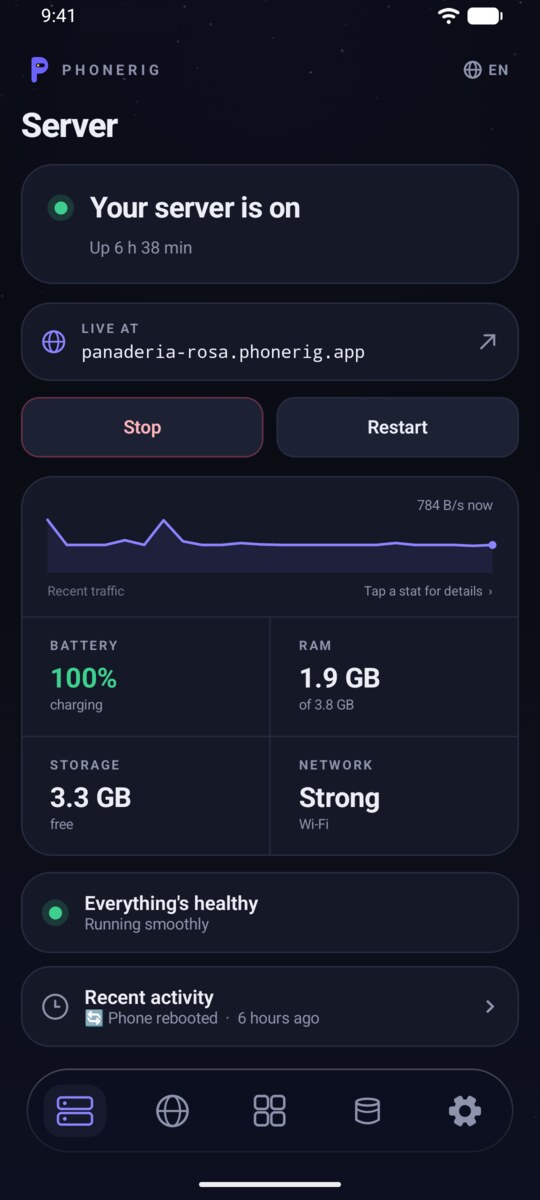
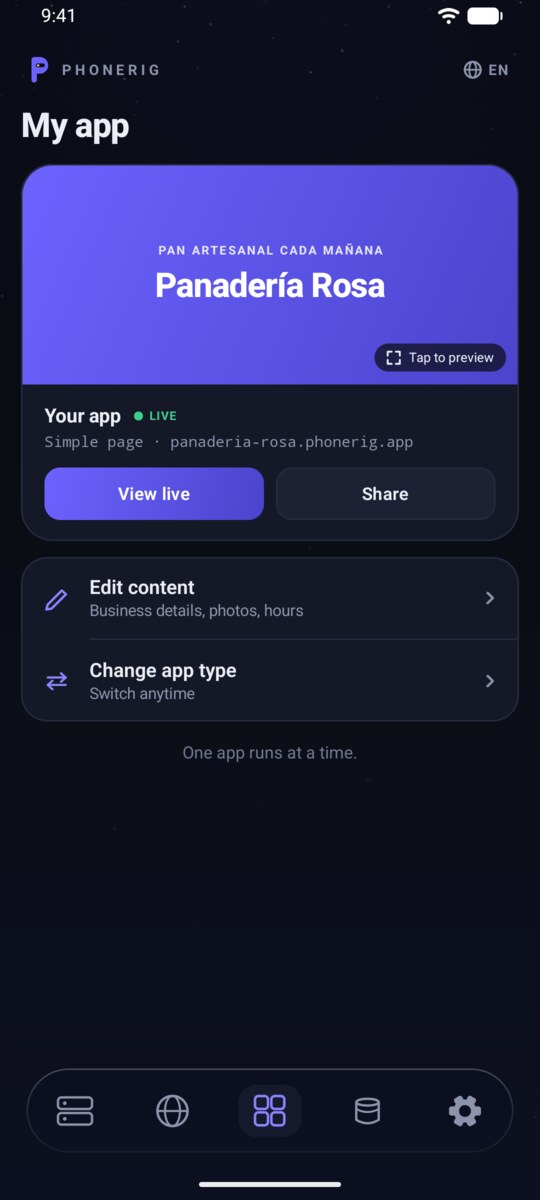
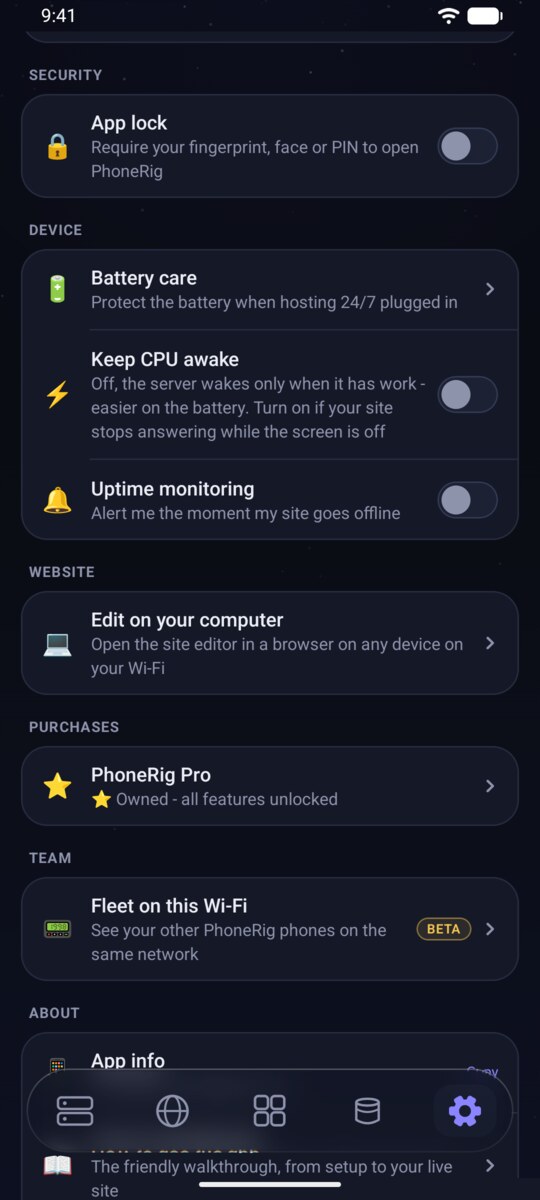
Give the phone in your drawer a second life: zero cloud bills, your data on your hardware, less e-waste. Here's everything people actually build with PhoneRig.
For a small business
Can I host a website on an Android phone?
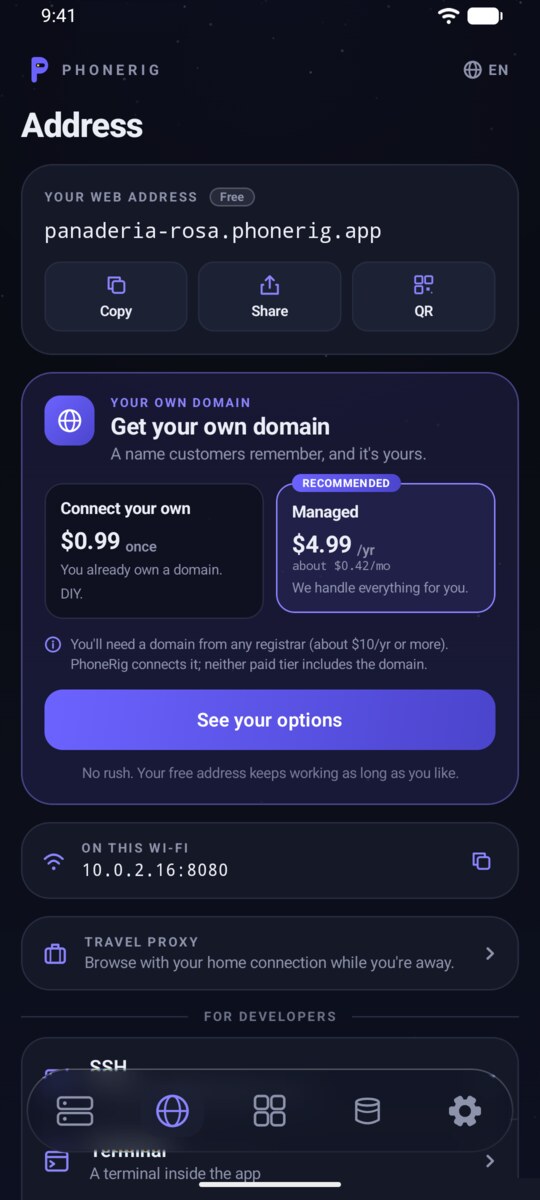
Yes. PhoneRig runs a real web server on the phone and makes it reachable over HTTPS through a secure tunnel - no port forwarding, no static IP. You get a free yourname.phonerig.app address, or connect your own domain.
A real business website, no monthly fees
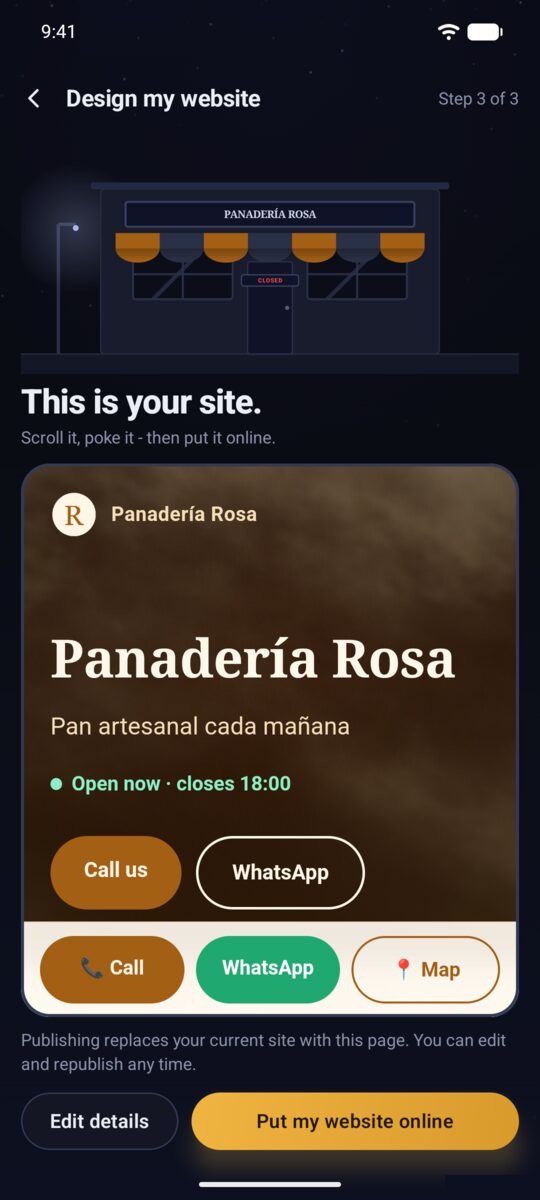
The built-in builder makes the page a small business actually needs: a menu with prices, day-by-day hours with a live Open now badge, photos, a map, and a QR code for the shop window. Edit it any time from the app - changes go live instantly.
Bookings straight to your WhatsApp
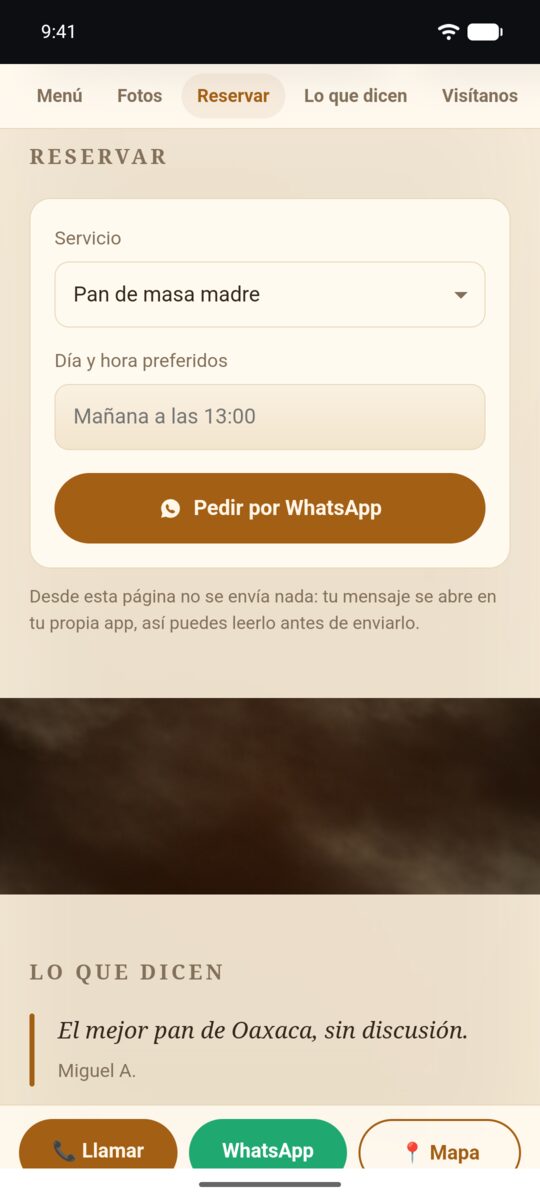
Visitors pick a service and a time; the request lands in your WhatsApp. No forms, no middleman, nothing stored on anyone else's servers.
Your own domain, with automatic HTTPS
yourname.com pointing at the phone; certificates handled. See the custom domain guide for the managed and DIY routes.
For creators and personal use
How do I self-host without a monthly bill?
Use hardware you already own. A spare phone plugged in on your Wi-Fi serves a page 24/7 for about the power draw of a nightlight - and the site is yours, not rented.
A portfolio or personal page you actually own
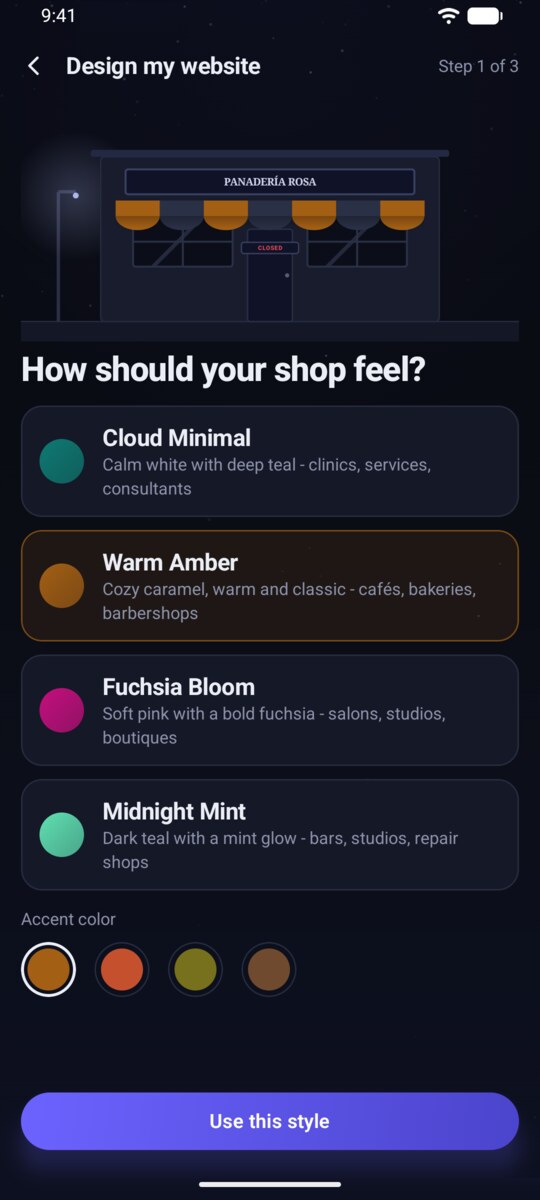
Not rented from a site builder, no ads bolted on. Pick a style, add your work, publish from the phone.
A blog in one tap
Full WordPress, running on the phone. One tap installs it; write and manage posts from any browser. How it hosts WordPress →
An event page
Wedding, birthday, meetup: photos, a map, and RSVP by WhatsApp. Live for as long as you need it, gone when you're done, free the whole time.
A shared photo album, without a cloud account
Make an album, send one link and a short passcode, and everyone who was there can look through the photos, download the ones they want, and add their own - from any browser, with nothing to install and no account to make. Guests type a name as they come in, so every picture shows who added it and you can filter the album down to one person. The photos live on your phone and land in your own gallery; nobody else's servers see them, and only you can delete anything. More on the photo albums page →
Several websites from one phone
The shop, the side project and the band can each have their own page and their own address on a single phone. Before you add one, PhoneRig shows you honestly how much room is left - and says so when the answer is not enough.
For developers and tinkerers
Can an old phone be a Linux server?
Yes - a surprisingly capable one. On most phones PhoneRig runs a real Ubuntu environment (some newer ones block it), and most Androids from the last few years have more RAM and faster storage than a budget VPS.
A pocket Linux server
Real Ubuntu, on a phone running the Linux engine: SSH in from your laptop (from your Wi-Fi or from anywhere), use the built-in terminal, or run VS Code in the browser (code-server). What else it can run →
Your own private Git server
Gitea, one tap to install: your code on your hardware, with issues, pull requests and a web UI - private by default. Needs the Linux engine.
A staging server with a real URL
Show a client work-in-progress from the phone in your drawer, or deploy what you built with an AI coding tool. A real HTTPS address, shareable in one tap.
Webhooks, bots and small APIs
Node, Python, whatever Ubuntu runs, on a phone with the Linux engine. A phone that's always on is a fine home for the small services that don't deserve a cloud bill.
Learn self-hosting safely
Break things on a spare phone, not on a bill. If an experiment goes sideways, reset and start again - nothing else in your life depends on it.
For your files
Can a phone replace my cloud storage?
For personal use, yes: your files live on a device you own and can hold in your hand - reachable from anywhere when you want them to be.
A personal cloud drive
Keep folders in sync across your devices (Syncthing, one tap to install), and share photos through a link and a passcode. Your files stay on your phone, not on someone else's servers.
Sync across devices without the cloud
Syncthing, device to device: folders stay in sync between your laptop, desktop and phones with no third party in the middle.
At home and on the road
What can a phone server do at home and when I travel?
The same phone works as a private home server or as your point of presence at home while you're away - your choice, switchable any time.
A home-only intranet
Wi-Fi-only mode: the server is reachable on your network and nowhere else. A family wiki, recipes, a LAN file drop - nothing exposed to the internet.
A travel proxy
On hotel Wi-Fi, browse through your home connection and appear at home. One SSH command, no extra software on the phone - the travel proxy guide has the setup. It's not an anonymity tool: your home connection identifies you. If you need anonymity, use Tor or a VPN service.
For teams (beta)
Can I run several phone servers together?
On the same network, yes. Fleet is LAN-local by design: the console is served locally and nothing goes to the cloud.
Several phones, one panel (beta)
Fleet shows your other PhoneRig phones on the same Wi-Fi: status, address and vitals for each, in one panel on your network. It doesn't manage phones on other networks - it's for the rigs in the room.
New to PhoneRig? The friendly walkthrough shows the setup start to finish - most of the uses above are one tap from there. For the complete list of what the app can do, see every feature in one page.